
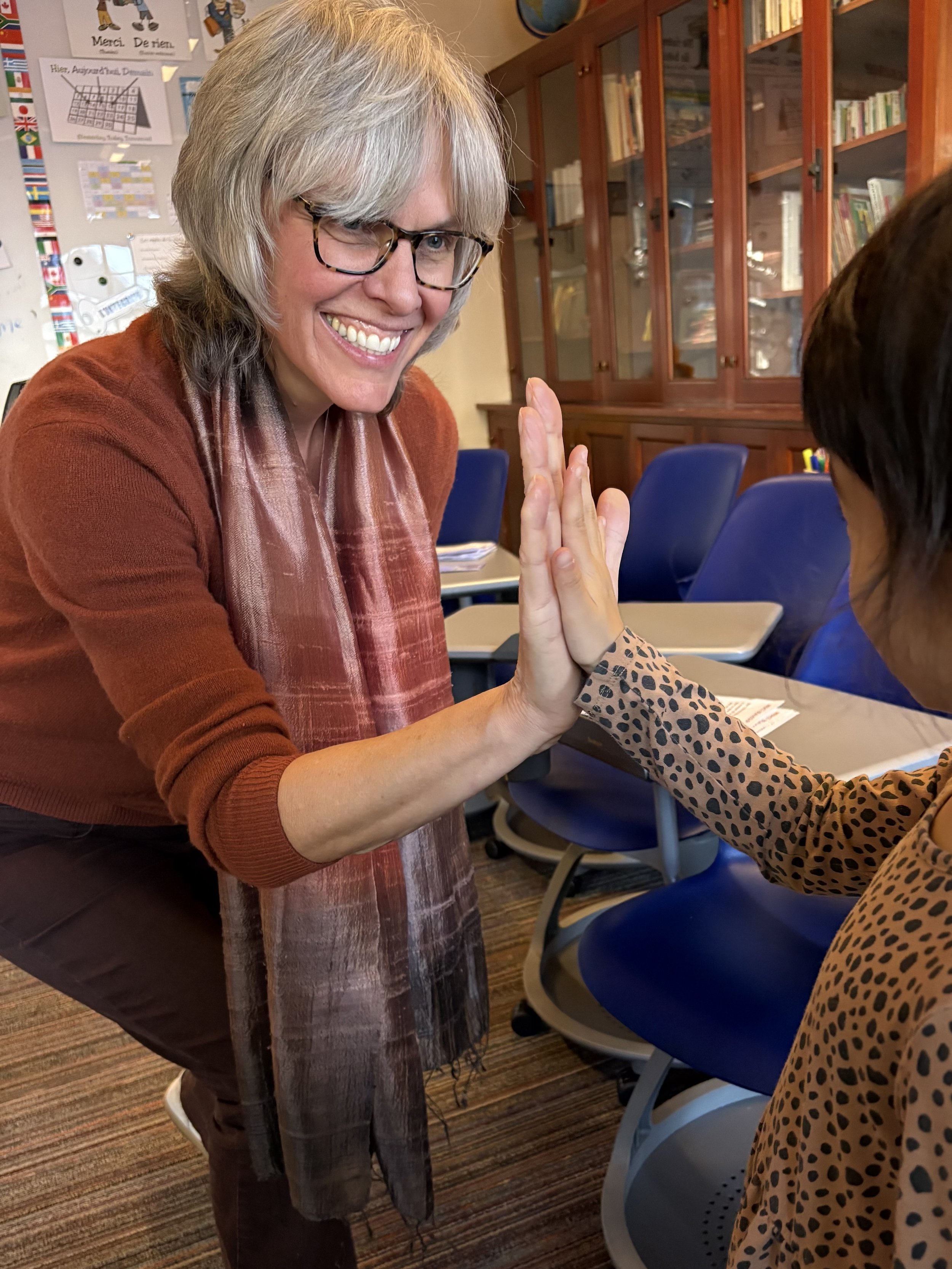
A student who feels successful will continue to take risks that will lead to even more success.
In our last post, we talked about keeping students accountable to speaking in the target language and the importance of finding a system that works. In this post, we will talk about how to encourage students and spur them on. There is a delicate balance between accountability and encouragement, and in an ideal classroom situation, the two work together to drive language acquisition.
Language learning is an inherently vulnerable process, and how one feels about it is a big factor in how much progress is made. A student who feels successful will continue to take risks that will lead to even more success. That student’s sense of accomplishment boosts his motivation, which in turn results in a bigger sense of accomplishment. Again, this is the ideal scenario!
In our first post in this series, we talked about how our role as language teacher is much like being a language coach. We give students activities that help them build their skills, we give feedback to help them hone those skills, and much like a coach, our job is to cheer them on. When students feel celebrated by their teachers, it fuels their motivation and gives them confidence to keep working at the long but rewarding process of learning a language.
So, what can we do as language teachers to encourage and empower our students in their language-learning journey? We need to cheer them on and celebrate their efforts. We need to foster a classroom atmosphere where students feel like we are their cheerleaders and that we are personally invested in their success. Here are a few practical ideas about how to do that:
Make eye contact with your students when they enter and exit the room. If your students are much shorter than you, squat down while you do this so that your eyes are at the same level.
Greet them by name and smile.
Give high fives (this is especially effective in early elementary classrooms)
Clap for them; encourage them to clap for one another.
Use encouraging rejoinders in the TL - Excellent ! Bravo ! Fantastique ! Incroyable !
When you notice them doing something especially well, let them know!
When you notice them doing something especially well, contact their parents and let them know too!
Give them billets/boletos or stickers to encourage them to participate!
There are many ways to give positive feedback, and it boils down to the kind of posture you have with your students. Showing interest and curiosity can go a long way. Give them compliments. Let them know that you are glad they are there! Pretend you are sad when they need to leave!
With our youngest students, we do a lot of chanting. It is a very effective way for them to practice saying the various questions that are the foundation of our program. It does wonders for their pronunciation and their awareness of the connection between the way the words are formed and how they are pronounced.
Sometimes, when students are learning a new chant or song, I will give them a collective “grade” on how they sang. I often start with a low score like 3/10 which I write on the board. Then I ask them to sing it again to see if they can get a better score. The second time around, they will do a little better, so I will change the grade to 7/10. They always want to try for a better score. The third time, they do much better and they usually get 10/10. They are so proud, and this positive feedback has motivated them to keep practicing and make their French better!
Another important part of creating an encouraging atmosphere is knowing how to respond to different students. Student motivation can vary, and different approaches will work well with different students. The better you know your students, the easier it is to know what will work. For some students, it is very important not to correct them publicly, but for others, it would be welcome and not a big deal. Some students need a lot of accountability and encouragement to motivate them, and others don’t. Getting to know our students is important, and identifying students who need the extra attention and encourage them in a way that motivates them can be effective.
One lesson that Denise and I have learned over many years of teaching is never to give up on the student for whom things don’t seem to be clicking. We have the blessing of seeing our students over a period of ten years, and it is remarkable how a struggling language student will suddenly turn a corner after years of giving the impression that they are not absorbing much. We encourage you to keep a positive posture toward these students and to celebrate their accomplishments, big or small.
We believe that anyone can learn a language. Our students move through the same program and end up with a variety of proficiency levels. Our main concern is not having them reach a particular level of proficiency. The most important thing is that they making good progress, and that their proficiency is increasing. To make good progress, feeling good about the process of learning the language is essential.
How do you help your students feel good about it?
Please enjoy this free poster to encourage your students.